Anzhi - Liverpool 1 @ 2.50
SURE : 100%
Thursday, November 8, 2012

Monday, October 22, 2012
Zidane: I have no problem with Mourinho
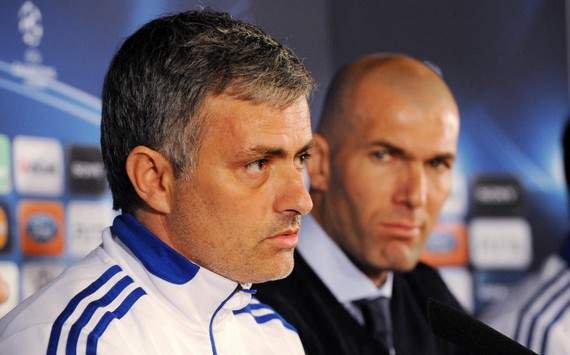
The legendary Frenchman has stressed that his relationship with the former Inter boss has not turned sour as he's learned a lot from the Madrid coach
Zinedine Zidane has insisted that he does not have any problems with Real Madrid coach Jose Mourinho, before adding that he has learned a lot from the Portuguese trainer.
A number of recent reports suggested that Zidane had left Madrid after falling out with Mourinho, but the former France international has made it clear there is no truth in the reports saying the duo have a troublesome relationship.
"I do not have a problem with Mourinho. On the contrary, I have learned a lot from him," Zidane was quoted as saying by Sport365.
"It is my passion to stand on the pitch on a daily basis. That's why I opted to return to France to form myself as a coach."
Zidane, 40, made over 200 official appearances for Real Madrid between 2001 and 2006.
"I do not have a problem with Mourinho. On the contrary, I have learned a lot from him," Zidane was quoted as saying by Sport365.
"It is my passion to stand on the pitch on a daily basis. That's why I opted to return to France to form myself as a coach."
Zidane, 40, made over 200 official appearances for Real Madrid between 2001 and 2006.
Tuesday, October 16, 2012
Abidal's agent comments on his client's return to football

The Blaugrana defender's representative has released a statement regarding the player's potential future at stepping back on the field.
Barcelona defender Eric Abidal's agent and best friend David Venditelli has given an outlook concerning a possible return to soccer for the France international.
The 33-year-old Frenchman was diagnosed with having a tumor on his liver back in March, 2011, after which he received well wishes from people all over the world, who are highly anticipating his recovery. He made a stunning return to the field just months later, but he required a liver transplant this past March before recently returning to training last week.
"His main objective is clearly to play again, but we don't know yet if it is possible," Venditelli toldFrance Football.
Venditelli then went on to express his worry regarding his client's ability to engage in the physical part of the sport.
"There are still some questions without answers," Venditelli said. "What will happen in the first contact? Will he have fear? Will he be dedicated in the duels like he has always been? I think he will come back. He is so eager to prove this to himself than i think he can make it."
"His main objective is clearly to play again, but we don't know yet if it is possible," Venditelli toldFrance Football.
Venditelli then went on to express his worry regarding his client's ability to engage in the physical part of the sport.
"There are still some questions without answers," Venditelli said. "What will happen in the first contact? Will he have fear? Will he be dedicated in the duels like he has always been? I think he will come back. He is so eager to prove this to himself than i think he can make it."
Panda conservation is not 'greenwash'

The man behind the deal that brought two pandas to a Scottish zoo has defended panda conservation against allegations of "greenwash".
Iain Valentine, Director of Animal Conservation at Edinburgh Zoo said the panda brought money into conservation.
Biologist and TV presenter, Simon Watt, warned against Chinese "greenwash" when weighing up the value of conservation projects.
The comments were made at a debate held during Biology Week.
The event "Do we need pandas? Choosing which species to save" was held at the Linnean Society on Monday 15 October 2012 and was organised by the Society of Biology.
Simon Watt was on the four-person panel and made his comments in answer to a question from the audience.

"Chinese greenwash, that's the kind of stuff we need to be thinking of," he said.
Greenwash is the deceptive marketing of green public image, when more substantial environmental policies are not being implemented.
"If we're going to be putting poster boys [such as pandas] on pedestals they're not going to be just used for good things".
He said that the pandas could distract attention from other areas where conservation money could be better spent.
Conservation 'cash cow'
Edinburgh Zoo's Director of Animal Conservation Mr Valentine, who was in the audience, explained from the floor of the debate that this did not match his experience of panda conservation.
"The pandas are paying for themselves. We're not taking our money away from any other species."
"The money that the pandas are making for us is going straight back to panda conservation, it's not detracting away from any other money in any of our other projects," he said.
Speaking after the event, he explained that pandas are a conservation "cash cow".
"I don't think pandas are a model for how conservation can be funded... they are unique within the animal world as they have an appeal which is unmatched by any other species."
"Panda conservation work needs to be held up as an great example of what can be done in terms of the conservation of a species. It's holistic, it's embracing all of the issues and it's working," he said.
"It's a good indication of the environmental credentials of the Chinese," he added.
Sitting on the panel with Simon Watt at the debate were environmental expert Dr Mark Avery, presenter and scientist Dr Yan Wong and Dr Sandra Knapp, Head of Plants Division at the Natural History Museum.
The discussion focused on the importance of conservation efforts to preserve habitats as part of an effort to save species.
"The panda debate turns into [a question of] if we concentrate on conserving pandas, do we end up conserving habitat?" said Dr Wong.
This concern for habitat is driven by concern for biodiversity.
"I think we have to focus where we get most biology for our buck," Simon Watt said, suggesting less well-known conservation projects such as Yasuni National Park, a biodiversity hotspot in Ecuador, which has 2,200 different species of tree.
"The panda's home is worth protecting but I think there are other places that are probably more worth protecting," he commented.
Speaking after the event, Mr Valentine said that panda reserves can also have very positive consequences on other species in their habitat using Wolong "the most important panda reserve" as an example.
"Its a world UNESCO site and a biosphere reserve because of its importance to pandas but also its importance for plants and many animal species."
"I would like to think it would exist even if pandas were not there as its so damned important but the fact is that it does have pandas and that just puts the icing on the cake."
Food price crisis: What crisis?

Without water, crops cannot grow and the world cannot eat. And this year, there hasn't been enough of it.
The US has seen its worst drought in more than 50 years, vast swathes of Russia have been left parched by lack of rain, India has had a dry monsoon, while rainfall in South America early in the year fell well below expectations.
As a direct result, harvests of many crops have been decimated, forcing the price of some cereals back up towards levels last seen four years ago, a time when high prices sparked riots in 12 countries across the world and forced the United Nations to call a food price crisis summit.
The lack of rain this year has raised fears we are rapidly heading for another price crunch.
The focus has been on US corn production, which has been all but wiped out in many regions. In fact, US corn inventories are running at just 6% of annual consumption, well below the 25% that is generally considered an appropriate buffer.
Soya-bean production is also well down, while grain production in Asia has been hammered, with yields in some countries down by more than 50%.
.jpg)
And yet most experts agree the situation is nothing like as dire as it was four years ago, nor in fact two years ago when droughts again hit food production hard, sending prices to record highs.
Prices are measured against expectations, and harvests have not been as bad as many had feared. More importantly, stocks are in better shape. Perhaps most importantly, key producers, in particular Russia, have not imposed the kinds of export bans that helped trigger previous price hikes.
These were particularly damaging as the world has become more dependent for its grain on the Commonwealth of Independent States, which includes some of the world's biggest producers of wheat, including Russia, Kazakhstan and unofficial member Ukraine.
"Big producers have been battered by drought but they are honouring their export contracts," says James Walton, chief economist at food experts IGD.
"If Russia or central Asian countries were going to do something, they would probably have done it by now."
The Agricultural Market Information System, which was established last year and allows the world's major food producers to work off common data as well as providing a forum for discussion, has played an important part.
"Governments are shying away from restrictive measures; supplies are not as bad and inventories are not as bad," says Abdolreza Abbassian, senior economist at the UN Food and Agriculture Organisation.
"Recent experiences have made people a little over sensitive, but [the situation] does not look as bad [as 2008]".
In fact, according to Mr Abbassian, there is no shortage of rice, despite patchy harvests, while inventories of wheat are good, and much higher than in 2007. Sugar production in Brazil has also been much better than expected, while China has generally had a good growing season, Mr Walton adds.
There is also less pressure on prices from biofuels, a "big factor" in the 2008 price spikes, Mr Abbassian says, when a record high for the price of oil drove demand for alternative fuels. Corn and sugar, for example, are used extensively in biofuels - in the US, 40% of all corn production goes into making ethanol. Not only is the oil price well below those highs, but the UN says fewer crops are being diverted towards biofuels.
Overall, then, fears of an impending food price crisis would appear to be exaggerated.
"There has been a lot of talk about food prices at the UN, the International Monetary Fund and the World Bank, and the general feeling is we are not in the same situation we were in in 2008," says Marc Sadler, senior agriculture economist at the World Bank.
Continue reading the main story

But while the chance of food prices returning to levels seen in 2008 and 2011 in the coming months may be slim, they remain at historically high levels, and the underlying factors driving them are here to stay.
Population growth and, more importantly, the rapidly growing middle classes in the developing world, are pushing demand for grain-intensive protein ever higher, while rising energy costs are pushing up the cost of supply. High food prices, therefore, are here to stay.
Long gone are the days of butter mountains and milk lakes as governments fundamentally rethink agricultural policy and cut back on subsidies to farmers.
Global inventories have fallen sharply since the turn of the century as a result - wheat stocks are down by almost a third, rice by more than 40%, and corn by a half.
And these stocks are unlikely to increase. As Mr Sadler says, "even in a good year we just about produce enough food to meet consumption needs".
Margins, therefore, are getting smaller and supplies ever more susceptible to shocks, such as the severe droughts experienced in the past five years. And extreme weather patterns appear to be becoming more commonplace. Experts are wary of blaming climate change, but many believe rising temperatures are having a major impact on rainfall. If they are right, then unpredictable and more extreme weather is here to stay.
'Biggest challenge' People in the developing are far more exposed to rises in the price of food
Those living in the developed West will be relatively unaffected, as produce in the shops is far removed from the raw commodity - wheat is a fairly small component in the cost of a loaf of bread, for example. In fact, the impact on the price of meat is more pronounced, as 5kg of grain are needed to produce 1kg of protein.
Even here, however, there has been a profound change in recent years, according to Mr Walton. "The era of cheap food which we take for granted is over. Food will continue to be available, but don't expect the price to go down," he says.
The impact on those living in poverty in the developing world - those who buy the raw ingredients to make their own produce, and who spend a far greater proportion of their income on food - is far, far greater.
"The global population will soon hit nine billion and everyone has to be fed. Making sure they are is the number one challenge of this century. This is not a question of can we, can't we? We have to," says Mr Sadler.
Dramatically cutting back on food waste, which currently accounts for a third of all food production, would be a start, but a huge increase in investment in global agriculture is also needed. If it fails to materialise, the consequences will be devastating.
Obama team raises expectations for debate with Romney

US President Barack Obama's team says he will make a "strong" comeback in Tuesday's debate rematch with his Republican challenger Mitt Romney.
Top aide Robert Gibbs says he expects Mr Obama to be "energetic" after his passive showing in the first debate.
The rivals will take questions on domestic and foreign policy from an audience of 80 undecided voters at a town hall-style forum in New York.
With 21 days to go until the election, the race is essentially deadlocked.
As he battles for a second term, the Democratic president is trying to hang on to narrow leads in many of the nine key swing states that are expected to decide who will win the White House.
'Passionate'
The 90-minute debate at Hofstra University on Long Island starts at 21:00 EDT on Tuesday (01:00 GMT on Wednesday). It will be moderated by CNN chief political correspondent Candy Crowley.
Continue reading the main storyElection Daily Diet
16 October
Which city has endured 73,000 political ads this year?
See today's Daily Election Diet
The president's campaign dropped the usual pre-debate tactic of lowering expectations, to adopt a more bullish, upbeat tone.
Mr Gibbs, a senior Obama aide, told MSNBC on Tuesday: "I think you will see somebody who will be strong, who will be passionate, who will be energetic."
Mr Romney - who has risen in the opinion polls since his first encounter this month with Mr Obama in Denver, Colorado - will aim to pull off another assured performance.
Mr Obama has been preparing for the debate since Saturday at a golf resort in the city of Williamsburg, Virginia. Mr Romney's advisers are putting him through his paces in his home state of Massachusetts.
"President Obama is going to have a better night than he had at the first debate," Romney spokesman Ryan Williams said.
He added that the Republican expects his rival to "come out swinging with dishonest and negative attacks".
After the last debate, Democrats questioned why Mr Obama did not challenge Mr Romney over his policies on tax, healthcare and jobs.
They also complained that Mr Obama had allowed the Republican to soften some of his most conservative stances.
Obama campaign aides say the president will not make the same mistake this time.
Clinton's Benghazi 'responsibility'
But the rivals must also strike a balance between attacking each other without coming across as too negative in front of the audience and the tens of millions of Americans watching on television.

On the eve of the debate, US Secretary of State Hillary Clinton took responsibility for last month's sacking of the US consulate in Libya, which the Romney campaign has used to attack the White House.
Mrs Clinton said that she - and not the president or vice-president - was to blame for any security lapses before the 11 September assault on the diplomatic compound in Benghazi, which left the US ambassador and three other Americans dead.
The Romney campaign has claimed the Libyan raid shows that the president's foreign policy is "unravelling", and the issue could well come up again in Tuesday's clash.
The third and final presidential debate is scheduled for 22 October in Boca Raton, Florida.
Subscribe to:
Posts (Atom)